Zambia's 2026 national budget is ZMW253.1 billion, the largest in the country's history. Every kwacha of it is voted to a ministry headquartered in Lusaka. No province has a budget line of its own, a guaranteed share of it, or a legal claim on any part of it. What a province actually receives in a given year is whatever is left after dozens of ministries, each deciding independently, choose where within their sector to spend.
The development data shows what that produces. Lusaka (27.0% poverty) and Copperbelt (35.9% poverty) sit at the top of the national league table. Muchinga (82.6% poverty), Western and Eastern (78.6% each), Northern (78.0%) and Luapula (77.3%) sit at the bottom — five provinces with no ministry headquarters, no assured allocation, and no statutory instrument that guarantees them anything beyond a flat, population-blind Constituency Development Fund payment. This is not a story about Zambia lacking resources. The 2026 budget is the country's largest ever. It is a story about a delivery architecture that was never built to route those resources to a place.
This paper tests that thesis against Zambia's own budget and planning record — the 2026 national budget and the Eighth National Development Plan that governs it — and finds the thesis holds. It then sets out a fix: a statutory Provincial Equalization Fund, built on the precedent Zambia has already legislated in the 2024 Constituency Development Fund Act, that pairs a guaranteed floor for every one of the ten provinces with a formula-weighted top-up for population, poverty and geographic dispersion; and a capacity-building programme that gives provinces the planning, procurement and accounting systems to actually spend what they are guaranteed. Together, these are the two things the current model withholds from every province except Lusaka: certainty, and the means to act on it.
The 2026 national budget: the largest budget with no address for a province
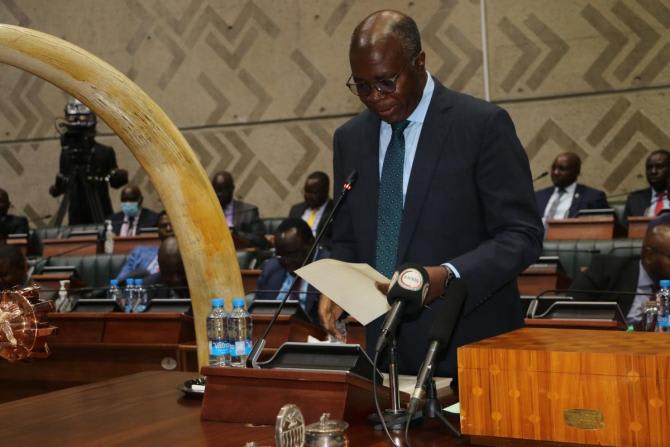
Finance Minister Situmbeko Musokotwane presented the 2026 budget to the National Assembly on 26 September 2025, under the theme "Consolidating Economic and Social Gains Towards a Prosperous, Resilient, and Equitable Zambia." It is Zambia's current, fully in-force budget: fiscal year 2026 runs the calendar year, so it is the appropriate "latest budget" to test against the national development plan.
How it is financed. Total resources of ZMW253.1 billion (27.4% of GDP) come overwhelmingly from domestic revenue — ZMW206.5 billion, 22.4% of GDP — with foreign grants (ZMW12.1 billion), domestic borrowing (ZMW21.6 billion) and foreign financing (ZMW12.9 billion) filling the gap. The fiscal deficit target is 2.1% of GDP, down sharply from 4.6% in 2025, alongside a 6.4% growth target and 6–8% inflation band. Zambia has restructured roughly 94% of its external debt, freeing some of the ZMW21.7 billion in external and ZMW52.0 billion in domestic debt service the budget still carries.
Within these totals sit the programmes voters recognise — the Farmer Input Support Programme (ZMW9.2 billion), free education (ZMW2.4 billion on top of the core education vote), medicines and medical supplies (ZMW6.4 billion), road infrastructure (ZMW14.5 billion), Social Cash Transfers to 1.5 million households (ZMW7.6 billion). Every one of these is a ministry vote, managed by a ministry headquartered in Lusaka, spent according to that ministry's own internal criteria for where a clinic, road or input depot gets built next.
The only instruments with a province's name on them. Three budget lines are explicitly sub-national: the Constituency Development Fund (ZMW6.2 billion, a flat ZMW40 million paid to each of Zambia's roughly 156 constituencies regardless of population or poverty), the Local Government Equalization Fund (ZMW1.5 billion, shared among all 116 local authorities), and a ZMW1.1 billion provincial airports allocation, itself a ministry-selected list of sites. Together they are ZMW8.8 billion — 3.5% of the total budget. There is no fourth line, no Yellow Book table, and no appropriations act that tells a province, in a single number, what it can expect to receive in a given year.
The plan behind the budget: the 8NDP, not the 7NDP, and one year left to deliver it
One correction worth making before the analysis: the plan currently governing Zambia's national budget is the Eighth National Development Plan (8NDP), 2022–2026, not the Seventh. The 7NDP ran 2017–2021 and has already closed out. The 8NDP is the live plan the 2026 budget is meant to deliver — and 2026 is its final year, which makes this an unusually good moment to ask how much of it actually happened. The analysis below tests the budget against the 8NDP; a successor plan (a 9NDP) will need to pick up whatever the 8NDP leaves undone, and the provincial funding model proposed later in this paper is written to carry into it.
The 8NDP is built on four strategic development areas: economic transformation and job creation, human and social development, environmental sustainability, and good governance. It names, in its own text, the obstacles it expects to fight for five years — low economic diversification, high youth unemployment, poverty and inequality, inadequate access to social services, and, explicitly, "slow decentralisation." That last item is the plan naming this paper's thesis as a known risk before the fact.
A mid-term evaluation of the 8NDP found real progress in several areas: governance reforms, the expansion of free education with increased teacher recruitment, expanded health worker recruitment, continued social protection programmes, and a return to macroeconomic stability. It found job creation and economic transformation lagging, climate resilience still weak, and implementation capacity a persistent constraint. Its single sharpest finding is a financing one: only a fraction of the planned development budget was actually released during the plan's mid-term period. That finding matters more than any other in this paper. It means the provincial gap this paper documents is not only a design flaw in how money is allocated — it is compounded by money that is budgeted, on paper, and then never disbursed at all. A province with no guaranteed line is doubly exposed: first to a formula that never named it, then to a release rate that falls short even of what was promised.
How the budget matches the plan
On the numbers that are easiest to compare, the 2026 budget does track the 8NDP. Education and health together take 23.3% of the budget, consistent with the plan's human and social development pillar; the return to a 2.1% deficit and 6.4% growth target tracks the plan's economic transformation pillar; free education and expanded Social Cash Transfers extend programmes the plan explicitly credits with progress. On sector totals, the plan and the budget are not in conflict.
Where they diverge is on the pillar the mid-term evaluation itself flagged as weakest: good governance, and within it, decentralisation. The 8NDP names slow decentralisation as an obstacle to overcome. The 2026 budget does not contain a single instrument built to overcome it. Every province has a Provincial Minister and a Provincial Permanent Secretary, but these are field offices of central ministries — deconcentrated administration, not devolved budget authority. A Provincial Permanent Secretary can coordinate what central ministries choose to spend in their province; none can decide, within a legally assured envelope, what their province spends on its own priorities. The plan's governance pillar and the budget's actual structure are, on this one point, unconnected: the plan names the disease, and the budget carries no instrument that treats it.
The spatial pattern in the poverty data makes the gap concrete. The five poorest provinces — Muchinga, Western, Eastern, Northern and Luapula — are also the five most rural (13–20% urban, against 82–83% in Lusaka and Copperbelt) and the five furthest from a ministry headquarters. The 8NDP's own diagnosis is that geography and poverty move together in Zambia. Its budget does not yet move money to counteract that pattern; left alone, ministry-level discretion tends to reinforce it, because existing infrastructure, staff housing and procurement capacity are already concentrated in the provinces that have them.
Strengths and weaknesses of the current allocation model
Strengths. The ministry-centric model has real advantages, and a redesign should keep them. Macroeconomic management has improved sharply — the deficit target fell from 4.6% to 2.1% of GDP in one year — which a fragmented, province-by-province budget would make harder to hold. Sectoral expertise is concentrated where the technical capacity already exists: a national Ministry of Health can run a single medicines procurement system more cheaply than ten provincial ones could. Accountability runs through one clear line to Parliament and the Auditor-General, rather than ten. Domestic revenue mobilisation is strong and rising (ZMW206.5 billion against ZMW12.1 billion in grants), reducing aid dependency. And Zambia already has two working equity instruments — the CDF and the Local Government Equalization Fund — that prove a formula-based, sub-national transfer is administratively possible; they are the precedent this paper builds on, not a system starting from zero.
Weaknesses. Four are structural. First, no province has a legally assured share of the budget: unlike South Africa (whose Constitution mandates an equitable share to provinces) or Kenya (which reserves a constitutional minimum of 15% of national revenue for counties), Zambia's Constitution requires only that "adequate resources" be provided for sub-national structures — a standard with no number attached to it, and in practice unmet. Second, the CDF, the one instrument that reaches every constituency, pays a flat ZMW40 million regardless of population or poverty; because provinces with more constituencies draw a larger aggregate CDF envelope, populous, better-off Lusaka and Copperbelt pull in more total CDF than sparser, poorer provinces, even before need is considered. Third, ministries retain full discretion over where within their sector to spend, and that discretion tends to follow existing infrastructure, staff preference and procurement ease — all of which already favour the line-of-rail corridor (Lusaka–Copperbelt–Southern–North-Western), reinforcing rather than closing the gap. Fourth, provincial administrations have thin planning, procurement and financial-management capacity, because they have never had to hold a budget of their own — a constraint the mid-term 8NDP evaluation's finding on under-released development spending suggests is already costing Zambia money it did appropriate.
Why the model can't guarantee a province anything
Follow a kwacha from the Yellow Book to a district in Muchinga and the mechanism becomes clear. It is voted to a ministry, not a place. The ministry's headquarters, in Lusaka, allocates it across programmes. Within a programme, regional or provincial offices execute what headquarters decides — they do not decide it themselves. Nowhere in that chain does a document exist that says "Muchinga's share of the 2026 budget is X." A province's real annual budget is the sum of fragments scattered across dozens of ministerial votes, decided by officials who owe no legal duty to distribute across provinces in any particular way, published nowhere as a single provincial total, and therefore never subject to a claim, an audit, or a target that anyone in that province can hold anyone accountable to.
This is why the thesis holds even in a year when Zambia raised and spent more money than ever before. Growth in the national budget does not mechanically translate into growth in what any one province receives, because the model was never built to make that translation. Lusaka does well under this model not because a formula favours it, but because it is where the ministries are, where the staff live, and where the existing infrastructure already sits — the same three facts, largely, whether the national budget is ZMW150 billion or ZMW253 billion. A model with no addressing mechanism for provinces will keep producing this pattern at any budget size, until an addressing mechanism is added.
A Provincial Equalization Fund: guaranteed, proportionate, provable
Zambia does not need to invent this instrument from nothing. The 2024 Constituency Development Fund Act already proves that Parliament will legislate a statutory, formula-based, ring-fenced transfer to sub-national units, paid every budget cycle regardless of which ministry wants the money more. The design below extends that precedent from constituencies to provinces, and fixes the one flaw in the CDF's own design: a flat, unweighted payment that does not adjust for how many people, or how much need, sit behind it.
Design principles. The fund should be (1) created by statute — a Provincial Equalization Fund Act — so no minister can withhold it in a difficult year; (2) formula-based and published, so every province can calculate its own entitlement before the budget is even tabled; (3) built in two parts, a floor and a weighted top-up, so that both fairness concerns in play — every province deserves something, and bigger or poorer provinces deserve more — are satisfied at once; and (4) reviewed on a fixed cycle (every five years, alongside each national development plan) rather than left to drift.
The formula. Of the pool: 40% is a guaranteed floor, split equally across all ten provinces — no province, however small or however wealthy, ever receives nothing. The remaining 60% is a weighted top-up: 25% of the pool by each province's share of national population, 25% by each province's share of the national poor population (population multiplied by its poverty rate — this is the redistributive engine, rewarding provinces with the most people living in poverty, not merely the highest rate), and 10% by each province's share of national land area, compensating for the real cost of building and maintaining infrastructure across large, sparsely populated territory.
Worked illustration. Applying this formula to the consolidated ZMW7.7 billion pool — the CDF's ZMW6.2 billion plus the LGEF's ZMW1.5 billion, exactly as appropriated in the 2026 budget, with no new money required to start — produces the following allocation:
Every province clears its ZMW308 million floor, so no province is shut out even in a difficult year. But Muchinga, the poorest and among the most sparsely populated provinces, ends up with the highest per-person allocation in the country — ZMW664 per resident, against ZMW249 in Lusaka — without Lusaka's own allocation falling below its share of national population and land. This is not new money and it is not a cut for anyone: it is the same ZMW7.7 billion Zambia already appropriates every year for the CDF and LGEF, redirected from a flat, unweighted payment to a formula that deliberately tilts toward where the need and the distance are greatest. As fiscal space allows, the pool can grow beyond ZMW7.7 billion on the same formula; it does not need new money to start.
This is the same mechanism South Africa and Kenya already run at larger scale. South Africa's Provincial Equitable Share weights education (48%), health (27%), a basic population share (16%), an institutional component (5%), poverty (3%) and economic activity (1%) — and is paid to provinces as of constitutional right. Kenya's Commission on Revenue Allocation formula for counties similarly blends population, a basic equal share, poverty, land area and fiscal responsibility, under a constitutional floor of at least 15% of national revenue reserved for counties. Zambia's version starts at ZMW7.7 billion — about 3% of the 2026 budget, and money already committed rather than new — and can scale on the same formula as fiscal space and provincial capacity both grow.
Capacity empowerment: what a province needs before it can spend a guarantee well
A guaranteed allocation that a province cannot plan, procure or account for well simply moves the failure downstream — which is exactly what the 8NDP mid-term finding on under-released development spending warns against. Money without capacity produces stalled projects and adverse audit findings, not development. Five systems need to exist in every province before, or alongside, the Equalization Fund going live:
1. A Provincial Planning and Budget Office, in each of the ten provincial capitals, staffed with economists, engineers and accountants who report to the Provincial Permanent Secretary and are trained to turn a fixed annual envelope into a costed, prioritised provincial development plan — the provincial-level equivalent of what the Ministry of Finance and National Planning already does nationally.
2. Provincial access to IFMIS, Zambia's Integrated Financial Management Information System, so provincial spending is visible to the Treasury in real time, on the same platform national ministries already use, rather than reconciled after the fact.
3. Devolved but supervised procurement authority, with thresholds that rise as a province demonstrates clean audit outcomes — starting with small works and inputs, graduating to larger infrastructure contracts once the Zambia Public Procurement Authority certifies provincial procurement units.
4. Technical staffing and retention incentives for engineers, planners and accountants willing to be posted to Muchinga, Western or Luapula rather than Lusaka — without which the equalization formula's money arrives in a province with no one qualified to spend it.
5. Independent audit and performance contracts, with the Auditor-General's office resourced to audit all ten provincial accounts annually, and each Provincial Permanent Secretary's own performance contract tied to disbursement and completion rates, not just receipt of funds.
Because capacity varies today — Lusaka and Copperbelt already have deeper administrative benches than Muchinga or Western — rollout should be phased by readiness, not uniform: an initial cohort of two or three provinces (one well-resourced, one poor and rural, to prove the model both ways) pilots the full system for two budget cycles before the remaining seven join, each graduating once its Provincial Planning and Budget Office and IFMIS connection are certified operational. This avoids the single biggest risk in decentralisation programmes elsewhere in the region: devolving money faster than the systems built to account for it.
Implementation roadmap: the winning strategy
The timing favours acting now: the 8NDP closes at the end of 2026, and its successor is being designed at exactly the moment this paper is written. A provincial funding model built into a 9NDP from its first year carries far more weight than one retrofitted onto a plan already in motion.
Table 2. Implementation roadmap
Phase
Timeframe
What happens
1. Legal foundation
Year 1 (2027)
Provincial Equalization Fund Act passed, repealing the CDF Act's constituency-fund mechanism and the Local Government Equalization Fund and consolidating both (ZMW7.7 billion in the 2026 budget) into the new Fund; in-progress CDF-funded projects novated to provincial administration, not frozen; National Decentralisation Secretariat (already established under Cabinet Office) designated as formula custodian; provincial revenue and expenditure accounts opened in IFMIS for all ten provinces
2. Pilot
Years 1–2 (2027–28)
Fund goes live in two or three provinces with Provincial Planning and Budget Offices certified operational; formula, floor and reporting mechanism tested and published; independent audit of pilot provinces' first full cycle
3. Phased national rollout
Years 2–4 (2028–30)
Remaining seven provinces graduate in as their capacity systems are certified, fastest-ready first; procurement thresholds rise with each province's audit track record; Equalization Fund pool scales beyond ZMW7.7 billion as fiscal space allows, guided by the debt-service trajectory already improving under the 2026 budget's restructuring gains
4. Full integration into the 9NDP
Years 3–5 (2029–31)
Provincial allocations become a standing Yellow Book table, reported against 9NDP targets exactly as sectoral ministry votes are today; formula reviewed and reweighted using fresh 2032 census and updated poverty survey data
Institutional home: joint stewardship between the Ministry of Finance and National Planning (which holds the purse and the formula) and the Ministry of Local Government and Rural Development (which holds the relationship with provincial and district administration), coordinated through the existing National Decentralisation Secretariat rather than a new agency. Monitoring should track two things above all others: the disbursement rate against each province's formula entitlement (closing the gap the 8NDP mid-term review exposed), and completion rates on funded infrastructure, published annually and province-by-province — so that "assured commitment" is not just a legal promise but a number every province, and every Zambian, can check.
Risks, trade-offs and political economy
No reform this paper proposes is free of resistance or risk, and a strategy that ignores that is not a winning one.
Resistance from ministries and MPs. A Provincial Equalization Fund that consolidates the CDF does not touch line-ministry sector budgets, but it does end the practice, in place since 2006, of individual Members of Parliament chairing constituency-level CDF committees with direct say over local project selection. That is real political control, and MPs will not give it up quietly. The most workable path keeps an MP-facing layer — constituency-level advisory input into the provincial plan — while moving the money and the final decision to the provincial administration, and sequencing the Act through Cabinet with the National Decentralisation Secretariat as sponsor, not any one sectoral ministry, so it reads as consolidation rather than one ministry's land grab.
Fiscal space and debt. Zambia has just brought its deficit down to 2.1% of GDP after restructuring roughly 94% of external debt — a fragile, hard-won gain. Because the Provincial Equalization Fund consolidates money Zambia already appropriates for the CDF and LGEF rather than adding new spending, it does not itself put that gain at risk. The discipline needed is on future growth of the pool: any increase beyond the ZMW7.7 billion starting point should be pegged to the same fiscal rules governing the rest of the budget, not exempted from them.
Unfunded mandates. The single fastest way to discredit this reform is to hand provinces a guaranteed allocation without the planning, procurement and audit capacity to spend it — producing stalled projects that then get blamed on decentralisation itself rather than on sequencing. This is why the capacity-building programme above is not optional scaffolding; it is a precondition, and the phased, readiness-based rollout exists specifically to prevent this failure mode.
Capture at provincial level. A guaranteed provincial envelope can be captured by provincial elites exactly as constituency-level funds have sometimes been captured locally. Mitigation lies in the same features that make the formula credible nationally: a published, auditable formula rather than discretionary top-ups; mandatory, independent annual audits; and public, province-by-province reporting of disbursement and completion rates, so capture is visible rather than buried in an unpublished ministerial line item.
Data gaps. The formula above rests on the 2022 census and the 2022 Living Conditions Monitoring Survey. Both need to be refreshed on a fixed cycle — ideally aligned to each new development plan — so the formula does not calcify around out-of-date poverty and population figures as provinces develop at different speeds.
Conclusion
Zambia's problem was never the size of its budget — ZMW253.1 billion is the largest in its history, and the 8NDP's own mid-term review shows real progress on governance, education and health. The problem is that no part of that budget is addressed to a province, so growth in the whole does not reliably become development in every part. The winning strategy is not a bigger budget; it is the same budget, plus an instrument — a statutory, formula-based Provincial Equalization Fund with a guaranteed floor and a proportionate top-up — that finally gives Muchinga, Western, Eastern, Northern, Luapula and Central the same thing Lusaka has always had by default: certainty. Paired with the planning, procurement and audit capacity to spend that certainty well, and phased in on a timeline that lands squarely inside Zambia's next national development plan, this is how a country with real resources in every province stops being a country where only four of ten actually see them. Success by the end of the next plan cycle looks like a single, simple fact this paper could not state about 2026: every Zambian, in every province, can point to a published number and know what their province was guaranteed — and can check, publicly, whether it arrived.