Zambia has spent years talking about the number of young people entering the labour market. The harder question is what the economy is actually equipped to do with them.
That question is putting vocational and technical education back into the spotlight.
For a long time, the education hierarchy was fairly clear: university was the preferred route, while vocational training was often treated as the alternative for students who did not take the academic path.
The labour market is beginning to challenge that hierarchy.
An economy does not run on degrees alone. It runs on people who can build, repair, install, operate, maintain and produce.
The skills gap is an economic problem
Consider a construction project.
It needs engineers and architects. But it also needs electricians, plumbers, welders, equipment operators, mechanics and technicians.
A mine needs geologists and accountants, but it also needs people who can maintain heavy equipment, work on electrical systems, operate machinery and keep industrial processes running.
A solar installation requires technical knowledge long after the financing and engineering plans are completed.
This is the less visible side of economic production: the practical skills that allow capital to become output.
When those skills are scarce, projects can become more expensive, take longer to complete or depend more heavily on imported expertise.
That makes vocational education more than an education-sector issue.
It is an economic infrastructure issue.
Zambia's growth sectors need technicians
Zambia's economic ambitions make the issue particularly relevant.
Mining remains heavily dependent on technical and industrial skills. Agriculture is becoming more mechanised and increasingly connected to irrigation, processing and cold-chain systems. Construction requires a large base of skilled tradespeople. Energy investment creates demand for electrical and renewable-energy technicians.
Digitalisation is creating another layer.
The economy does not only need programmers. It needs people who can install networks, maintain computers, configure equipment and keep digital systems operational.
The common thread is simple: investment creates demand for skills.
If the skills are unavailable locally, the country either imports them, delays deployment or leaves part of the investment's potential value unrealised.
The qualification problem
There is, however, a danger in responding by simply increasing enrolment in vocational institutions.
More certificates do not automatically mean more skills.
The real test is whether a graduate can perform a task in a real workplace.
Can they diagnose a fault? Operate equipment? Read technical drawings? Install a system safely? Maintain machinery? Solve an unexpected problem?
This is where the connection between colleges and employers becomes critical.
Training institutions need functioning workshops, current equipment and instructors who understand contemporary industry practice. Students need meaningful workplace exposure, not simply theoretical instruction followed by an examination.
The distinction is important because employers do not ultimately hire certificates.
They hire capability.
The equipment problem
Technical education is also unusually sensitive to underinvestment.
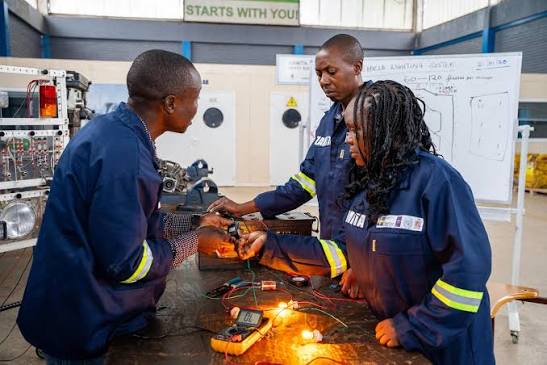
A university student can read a textbook about electrical engineering. A vocational student needs somewhere to wire a system.
A student learning motor-vehicle mechanics needs access to vehicles and diagnostic equipment. A welding student needs functioning welding equipment. An ICT technician needs actual networks and computers to configure and troubleshoot.
That makes vocational education relatively capital-intensive.
The policy implication is straightforward: expanding access without investing in equipment risks producing a larger system without producing proportionally better skills.
The quality of the workshop may matter as much as the size of the classroom.
The entrepreneurship argument
There is another economic advantage.
Some technical skills can be converted into businesses relatively quickly.
A qualified electrician can provide installation and maintenance services. A mechanic can operate a workshop. A welder can supply construction or agricultural businesses. A refrigeration technician can service shops, restaurants and other commercial customers.
Not every graduate will become an entrepreneur, and vocational education should not be sold as a guaranteed route into self-employment.
But technical skills can lower the barrier between training and earning.
That matters in an economy where formal wage employment cannot absorb everyone entering the labour market.
Changing the status of technical work
The deeper challenge may be cultural.
If vocational education continues to be presented as the route for students who “could not make it” academically, Zambia will struggle to attract some of the people it needs most.
A productive economy needs different kinds of intelligence.
It needs people who understand theory. It also needs people who can turn that theory into a functioning machine, building, electrical system, production line or digital network.
The prestige attached to different careers can therefore have economic consequences.
If society consistently rewards academic credentials while undervaluing technical competence, students may continue choosing qualifications according to status rather than labour-market demand.
The bigger question
Zambia's vocational education debate should therefore move beyond enrolment figures and graduation numbers.
The more useful questions are economic ones.
Are graduates finding productive work? Are employers getting the skills they need? Are training institutions equipped with current technology? Are apprenticeships connecting students to industry? And are qualifications translating into higher productivity and incomes?
Those are harder questions than counting certificates.
They are also the questions that determine whether vocational education becomes another credential pipeline or a genuine part of Zambia's productive economy.
The moment for vocational training may finally be arriving.
But the opportunity is not simply to produce more technicians.
It is to build a labour force capable of turning Zambia's investments in mines, farms, factories, construction, energy and technology into actual economic output.
The real measure of vocational education is not how many people it graduates. It is how much productive capacity those graduates add to the economy.