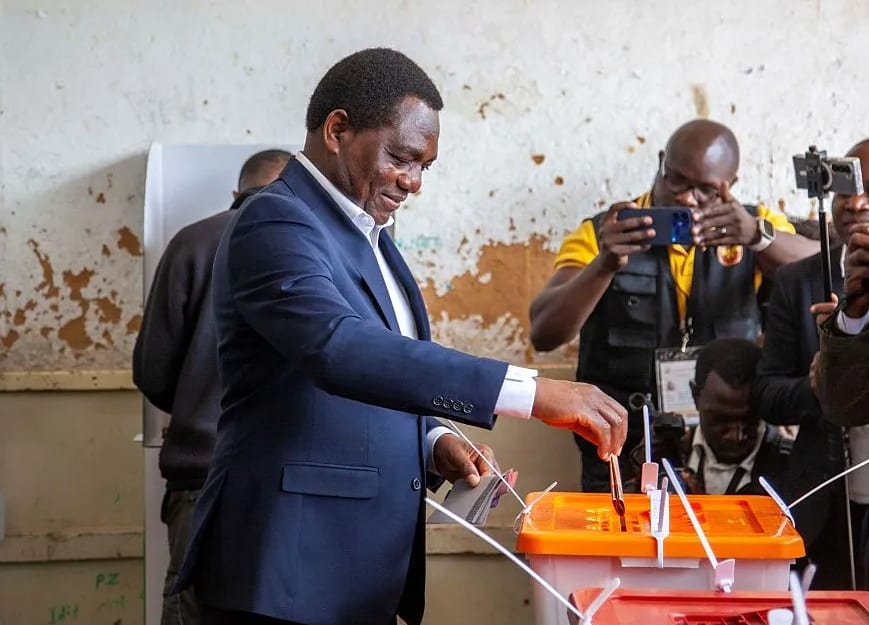
President Hakainde Hichilema’s re-election gives Zambia something that has become increasingly valuable to the economy: policy continuity. After a first term dominated by debt restructuring, fiscal consolidation and efforts to restore investor confidence, the second term begins from a markedly different economic position. Zambia is no longer dealing primarily with the immediate consequences of a sovereign debt crisis. The bigger question now is whether the stability achieved over the past five years can be translated into stronger growth, better incomes and broader economic opportunity.
The August 2026 election therefore has significance beyond the political outcome. For investors, businesses and households, it provides greater clarity about the direction of economic policy over the next five years. However, continuity should not be mistaken for a guarantee of prosperity. The economic challenges facing Zambia have changed, rather than disappeared.
From economic repair to economic expansion
The defining economic story of Hichilema’s first term was largely one of economic repair. Zambia entered his administration facing a severe debt crisis, limited fiscal space, high inflation and weakened investor confidence. Debt restructuring and the IMF-supported programme became central to restoring macroeconomic stability.
There has been meaningful progress. Zambia has completed its IMF Extended Credit Facility programme, while substantial progress has been made in restructuring the country's external debt. Inflation has also fallen significantly from the exceptionally high levels experienced in previous years, while international reserves have strengthened. These developments matter because economic recovery is not simply about GDP growth. It is also about whether businesses and investors believe government finances, monetary policy, taxation and the regulatory environment are becoming more predictable.
The second term, however, presents a different challenge. The question is no longer simply how Zambia can stabilise its economy, but how that stability can be used to generate sustained economic expansion. That is a much harder task because growth must now become more visible in employment, household incomes and business activity.
The copper opportunity
Copper will remain at the centre of Zambia’s economic story. Global demand for the metal is expected to remain strong because of its importance in electricity infrastructure, renewable energy, electric vehicles and other technologies associated with the energy transition. Zambia is therefore entering the second Hichilema term with a potentially significant opportunity.
Higher copper production can generate export earnings, foreign exchange, tax revenues and employment. Increased investment in mining can also stimulate demand for transport, engineering, construction, financial services and other businesses. But there is an important question behind the headline numbers: how much value does Zambia actually capture from its mineral wealth?
The long-term opportunity is not simply to produce more copper. It is to build a wider domestic economy around copper. That means stronger local supply chains, more Zambian participation in mining services, greater investment in skills and technology and, where commercially viable, greater processing and manufacturing activity. If mining investment increases without creating meaningful linkages with the rest of the economy, the benefits will remain narrower than they could be.
The cost-of-living test
Perhaps the most important economic challenge facing the government is also the most immediate one for ordinary households. Macroeconomic indicators can improve while households continue to feel financially stretched. Inflation has fallen, but lower inflation does not mean lower prices. It means prices are increasing more slowly. A household that experienced years of high inflation can therefore continue to feel pressure even after inflation returns to more manageable levels.
This distinction will matter during the second term. The success of economic policy will increasingly be judged not only by inflation, international reserves or debt ratios, but by whether households experience improvements in purchasing power and employment. The ultimate test of economic stabilisation is whether people can feel it in their daily lives.
Growth beyond copper
Zambia's long-term economic prospects will depend on whether the country can diversify beyond mining. Agriculture remains central to employment and rural incomes, while manufacturing and services have considerable potential to absorb a growing workforce. However, diversification requires more than identifying promising sectors.
Businesses need reliable electricity, efficient transport, access to finance, digital infrastructure and predictable regulation. Without these foundations, diversification will remain difficult regardless of how attractive Zambia's natural resources are. Energy may be particularly important. The country's dependence on hydropower has exposed the economy to drought and changing weather patterns, while electricity shortages can reduce mining output, disrupt manufacturing and increase costs for businesses.
A more resilient energy system could therefore become one of the most important investments of the second term. Zambia's ability to add solar, thermal and other generation capacity alongside hydropower will have implications far beyond the electricity sector. Reliable power is ultimately a prerequisite for industrialisation.
The debt lesson
Zambia's debt restructuring is one of the defining economic developments of the Hichilema administration. But restructuring should not be interpreted as the end of the debt problem. The more important lesson is that Zambia has experienced the consequences of borrowing without sufficient regard to the country's capacity to repay.
The government will face considerable pressure during the second term to increase spending on infrastructure, public services, wages and social programmes. Some of this spending will be necessary. The challenge will be ensuring that increased expenditure contributes to productive capacity rather than simply expanding recurrent obligations.
The distinction between borrowing to build an asset that generates future economic value and borrowing to finance consumption will become increasingly important. For Zambia, fiscal discipline is therefore not simply an IMF requirement. It is a lesson from the country's own recent economic history.
What does this mean for businesses?
For the private sector, the re-election primarily provides greater certainty. Companies can make investment decisions with a clearer understanding of the policy environment over the next five years. This could benefit sectors such as mining, agriculture, energy, manufacturing, financial services and technology.
But attracting foreign investment should not be the only objective. One of the most important measures of the second term will be whether new investment creates opportunities for Zambian businesses. A mining project that imports most of its equipment, services and expertise creates a different economic impact from one that develops competitive local suppliers. Similarly, infrastructure investment has greater long-term value when it creates productive ecosystems around it.
The next stage of Zambia's economic development should therefore focus not just on capital coming into Zambia, but on economic value staying in Zambia.
A new phase of the IMF relationship
Zambia's relationship with the IMF is also likely to evolve. The previous programme was heavily focused on restoring macroeconomic stability and addressing debt sustainability. A successor programme, if agreed, will operate in a different environment. The challenge will be maintaining fiscal and monetary discipline while creating enough space for investment and private-sector growth.
That balance will be critical. Too much austerity can constrain economic activity and public investment, while too much spending can recreate fiscal pressures. The second term will require a careful middle ground: maintaining credibility while creating the conditions for productive investment.
The bigger question
Hichilema's re-election does not represent either an automatic economic victory or a clean slate. It represents continuity at a particularly important moment for the Zambian economy. The first term was largely about restoring stability after a period of severe economic disruption. The second term now has the opportunity—and the burden—of turning that stability into transformation.
That transformation should ultimately be measured in practical terms. Are more Zambians finding productive employment? Are local businesses growing? Is electricity becoming more reliable? Is agriculture becoming more productive? Is Zambia capturing more value from its mineral resources? Are household incomes rising faster than the cost of living? And, perhaps most importantly, is economic growth becoming less dependent on copper prices and government spending?
These questions will matter more than the election itself. The re-election provides Zambia with five more years of policy continuity. What happens during those five years will determine whether the country simply consolidates the gains of economic stabilisation or takes the more difficult step towards sustained, broad-based prosperity.
The first term was about repairing the Zambian economy. The second must be about making it work for more Zambians.