Education Infrastructure, Reimagined
For years, the digital transformation of education has been built around a simple assumption: connect the school to the internet, and digital learning will follow.
But across much of Sub-Saharan Africa, that assumption does not always hold.
Schools can face unreliable connectivity, expensive data, intermittent electricity, limited computing infrastructure and insufficient technical support. Even where mobile internet is available, a school cannot necessarily afford to put hundreds of learners online at the same time.
This raises a different question:
What if a school did not need a permanent internet connection to access a modern digital learning environment?
That is the idea behind a new approach to education infrastructure being explored by Nsembe Technologies.
Bringing the infrastructure closer to the learner
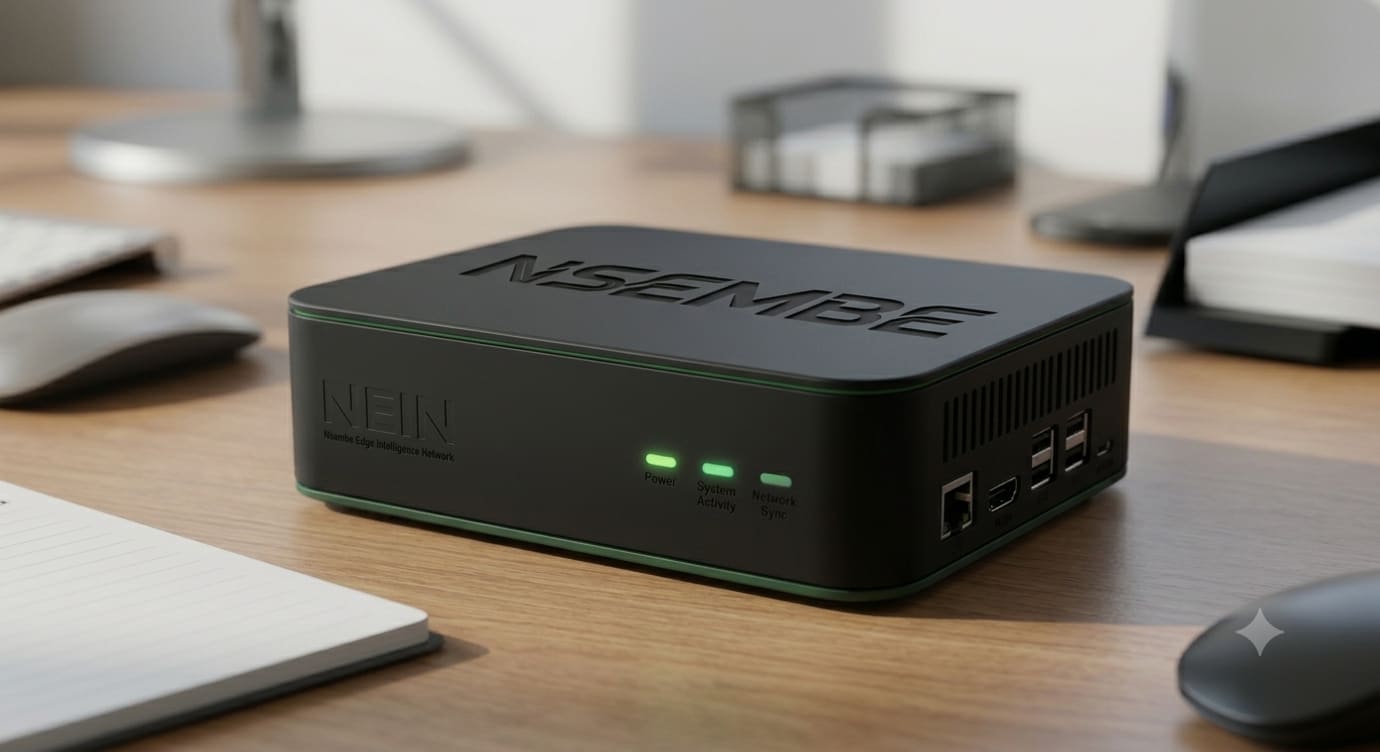
Nsembe is testing local server units designed to operate directly within schools. Instead of sending every request across the internet to a distant cloud server, learning resources can be stored and delivered locally over the school's own network.
A teacher or learner can connect to the school network using a phone, tablet or computer and access digital content from a server located on the premises.
The result is a different model of digital education:
the internet becomes an optional connection to the wider world, rather than the foundation on which the entire school system depends.
Digital libraries, lessons, assessments, school management tools and other educational resources can be hosted locally and accessed even when external connectivity is unavailable.
Designed for environments where infrastructure is limited
This approach is particularly relevant in schools where infrastructure constraints are not temporary inconveniences but structural realities.
A school may have:
- limited or expensive internet connectivity;
- unreliable electricity;
- insufficient computers;
- multiple learners sharing devices;
- poor network coverage;
- limited IT support; or
- long periods where the school is effectively offline.
Traditional cloud-based platforms can struggle in these environments because they assume reliable communication between the user's device and a remote server.
A local infrastructure model changes the architecture.
Instead of:
Learner → Internet → Cloud → Internet → Learner
the school can operate more like:
Learner → Local Network → School Server → Learning Content
This dramatically reduces the amount of infrastructure required to deliver basic digital learning services.
A school can become its own digital node
The longer-term vision extends beyond simply installing a server in a classroom.
Nsembe sees schools as potential digital nodes within a distributed education infrastructure.
Each node can provide computing, storage and educational services locally while remaining capable of connecting to wider networks when connectivity becomes available.
When the internet is available, the node can synchronise content, software updates, administrative information or other data with external systems.
When the connection disappears, the local system continues operating.
This creates an important principle for infrastructure design:
connectivity should enhance the system, not determine whether the system works.
From digital content to digital infrastructure
The distinction is important.
Providing a school with a collection of PDF files or videos is not the same as building digital infrastructure.
Infrastructure means creating an environment in which learners and teachers can continuously interact with digital services.
A local server can potentially support a broader ecosystem:
- Learning management systems
- Digital libraries
- Curriculum-aligned content
- Offline assessments
- Teacher resources
- School administration
- Student records
- Local applications
- Educational media
- Data collection and analytics
- Local AI and intelligent learning services
Because these services operate within the school environment, they can be designed around the realities of the local institution rather than around the assumption of permanent broadband access.
Infrastructure first, connectivity second
This approach does not reject the internet.
Quite the opposite.
Internet connectivity remains critical for accessing global knowledge, communicating with other institutions, updating systems and connecting schools to national and international education networks.
The difference is architectural.
Rather than making connectivity the single point of failure, schools can have a local digital core that continues operating independently.
Connectivity can then be layered on top.
A school might begin completely offline, later add mobile broadband, then fibre, satellite or other connectivity as those options become economically and geographically viable.
The underlying infrastructure does not need to be replaced each time the connectivity environment changes.
Building for the realities of African schools
Education technology is often designed for environments where electricity, broadband and computing resources are assumed to be readily available.
Nsembe is exploring a different design philosophy: start with the constraints.
That means thinking about power consumption, hardware cost, local network performance, maintenance, storage capacity and the ability of a school to continue operating during periods of limited connectivity.
It also means considering what happens after the technology is installed.
A useful education system is not simply one that works in a technology demonstration. It must work in a real school, with real teachers, real learners and real infrastructure constraints.
The beginning of a distributed education network
The local server concept is only one part of a larger direction Nsembe is exploring.
If schools can operate as independent digital nodes, those nodes can eventually become part of a much larger distributed network.
A school in Lusaka could operate its own local infrastructure.
A school in Chinsali could do the same.
A school in Nakonde could operate independently while periodically synchronising with external systems.
Over time, these nodes could form a distributed education network capable of moving content, software, data and intelligence between schools without requiring every interaction to pass through a central cloud.
This could become particularly powerful as new connectivity technologies—including satellite and next-generation mobile networks—expand access to previously underserved areas.
Reimagining the digital school
The future of digital education should not be defined solely by whether a school has broadband.
It should be defined by whether learners can reliably access the tools and knowledge they need.
That requires us to rethink the infrastructure underneath education technology.
Sometimes the most important innovation is not putting everything in the cloud.
Sometimes it is bringing the cloud closer to the classroom.
Nsembe Technologies is exploring what that future could look like: schools equipped with local computing infrastructure, capable of delivering digital learning independently while remaining connected to the wider digital world when connectivity is available.
The objective is simple:
build education systems that continue to work—even when the internet doesn't.