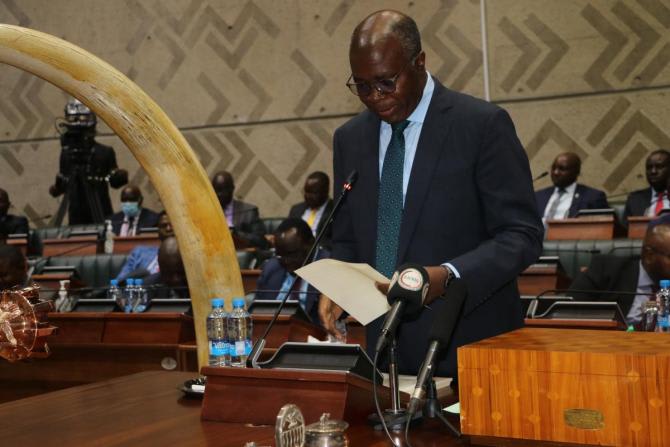
Finance Minister Situmbeko Musokotwane will present Zambia’s 2027 National Budget on October 30, against ambitious targets for economic growth, copper production, electricity generation and fiscal consolidation. The proposed fiscal deficit of 0.2% of GDP is particularly striking. But the real test is whether the numbers will hold during implementation — and what the Government’s financing strategy means for businesses.
The K19.9 billion supplementary budget proposed for 2026 illustrates the challenge. Agriculture accounts for K15.8 billion, including K14.7 billion to pay farmers who supplied maize to the Food Reserve Agency (FRA). The FRA purchased 2.7 million tonnes against an original target of 500,000 tonnes. Other allocations include K540 million for university tuition and allowances, K422.5 million for Defence and K300 million for contingencies.
The financing plan relies on K18 billion in additional domestic borrowing, supplemented by K1.3 billion in additional revenue collections and K510.8 million in donor funding, alongside smaller savings and unspent balances.
The maize purchases may be justified by food-security concerns. The fiscal question is whether such expenditure pressures are adequately anticipated in the original budget. When spending significantly exceeds initial estimates, Government must find additional revenue, cut other expenditure or borrow more. A supplementary budget can be necessary, but repeated adjustments make the credibility of the original fiscal targets harder to assess.
The bigger question is what domestic borrowing means for the private sector.
Government borrowing competes with businesses for financial resources. Banks and institutional investors compare lending to private firms with investing in Treasury bills and Government bonds. When government securities offer attractive returns relative to the risks and costs of commercial lending, financial institutions have an incentive to allocate more funds to them.
This is the crowding-out risk: businesses may face higher borrowing costs or reduced access to credit because Government absorbs a larger share of available domestic financing.
The effect is not automatic. Domestic borrowing can also mobilise savings, support economic activity and finance necessary public expenditure. Its impact depends on market liquidity, investor demand, the maturity structure of government debt and the availability of alternative funding. But the risk deserves attention when private investment is expected to drive faster economic growth.
A lower policy rate does not guarantee cheaper business loans.
The Bank of Zambia’s policy rate influences monetary conditions, but commercial lending rates also reflect banks’ funding costs, credit risks, inflation expectations and returns available on alternative investments.
If the policy rate declines while Government continues borrowing heavily, attractive Treasury bill and bond yields could limit the reduction in commercial lending rates. Banks may still prefer government securities to loans for businesses perceived as riskier, particularly small and medium-sized enterprises.
The result could be a widening gap between monetary easing and the financing conditions businesses actually experience. A lower policy rate would offer limited relief to an SME if its working-capital loan remains expensive or its application is rejected.
This matters for investment in machinery, inventories, construction and expansion. Zambia cannot sustainably pursue growth of 6–7% while productive businesses struggle to access affordable finance.
The scale of refinancing also matters. Government’s 2026 Annual Borrowing Plan projected K106 billion in gross domestic borrowing, including substantial refinancing of maturing debt. Gross borrowing should not be confused with new deficit financing: much of it replaces existing obligations. Nevertheless, refinancing requires Government to return to the domestic market, while debt-service payments continue to place pressure on public resources.
Zambia is therefore managing two related challenges: financing current expenditure and refinancing past borrowing. The 2027 Budget needs to show how both can be managed without undermining private investment.
The Government’s Grow Zambia Agenda provides the economic rationale for getting this balance right. Higher copper production should create opportunities for local suppliers and exporters. More electricity should support mines, manufacturers and agricultural businesses. Higher agricultural output should strengthen rural incomes and food security.
The test is whether public expenditure expands productive capacity and generates future economic returns, rather than simply increasing spending.
For the 2027 Budget, three questions deserve particular attention: Are the revenue and expenditure assumptions realistic? How much domestic financing will Government require, including refinancing? And will its borrowing strategy leave sufficient capital available for businesses?
The projected 0.2% deficit is an important headline, but the private sector will judge the Budget partly by what happens to credit availability, lending rates and investment.
The central trade-off is clear: Government must finance its obligations while creating room for businesses to finance growth. Fiscal consolidation and private-sector investment can reinforce each other, but only if the financing strategy supports both.
On October 30, the important question will not simply be how much Government plans to spend. It will be whether the Budget can deliver fiscal discipline without making productive investment harder to finance.