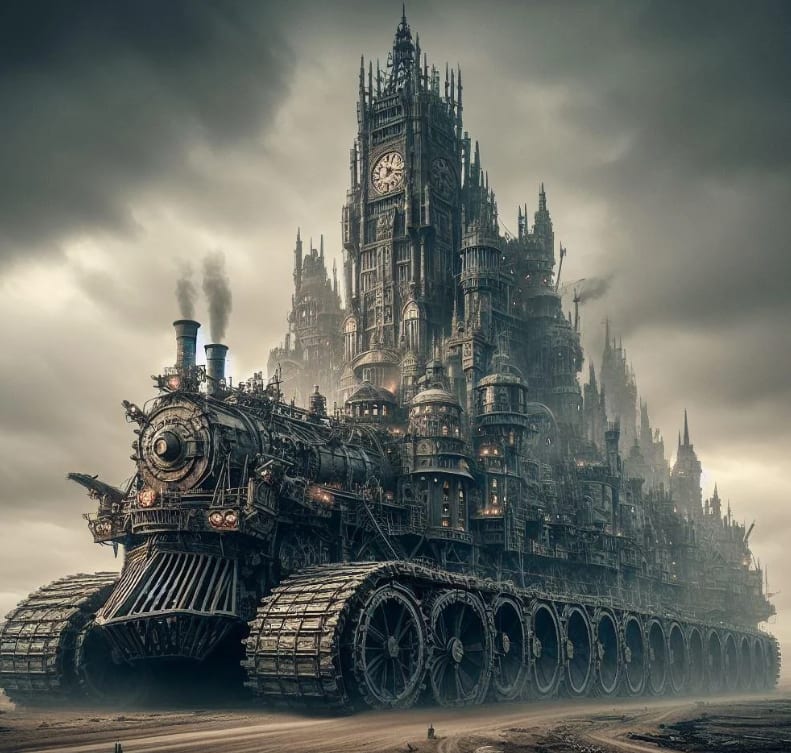
Deep beneath the city stood a machine that had been running for as long as anyone could remember.
They called it The Immortal Engine.
Nobody knew exactly when it had been built. Some said it was designed by economists. Others said engineers had merely inherited it from generations before them.
But everyone knew one thing:
The engine could never stop.
Inside it lived millions of people.
Some worked in the food chambers. Others operated transport systems, factories, banks and shops. There were farmers, traders, teachers, miners and mechanics.
Every morning, the engine moved.
And every morning, the engineers watched its gauges.
One gauge mattered more than almost any other.
It was called INFLATION.
Inflation did not tell them whether the engine was moving.
The engine was always moving.
Instead, it told them how quickly the cost of living inside the engine was changing.
When inflation was rising rapidly, the engineers knew something was happening inside the machine.
Perhaps it was overheating.
Perhaps fuel was becoming expensive.
Perhaps too much pressure was building in one part of the system.
Or perhaps several problems were happening at once.
The engineers therefore had different departments.
And, importantly, they did not all control the same parts of the machine.
The Department of Monetary Controls
On the eastern side of the engine was a large control room.
Above the door was written:
BANK OF ZAMBIA — MONETARY CONTROL
Inside sat the monetary engineers.
Their most important instrument was a giant lever called the POLICY RATE.
The lever controlled the cost of borrowing across the engine.
When the engineers raised the lever, borrowing generally became more expensive.
The idea was simple:
If people and businesses were borrowing and spending too aggressively, raising the rate could help slow demand.
It was like pressing the engine's brake.
But brakes were not meant to be pressed forever.
If the engine was already slowing too much, keeping the brake down could create another problem.
Factories could slow.
Businesses could postpone investment.
Consumers could reduce spending.
Economic activity could weaken.
So the monetary engineers constantly asked:
Is the engine moving too fast, or are we already slowing it too much?
The Energy Department
On the western side of the machine was another control room.
This one belonged to the Energy Regulation Engineers.
They controlled something very different.
They did not control the brake.
They controlled the fuel system.
Fuel was the energy that kept the engine moving.
But fuel had a cost.
When the price of fuel increased, almost everything connected to the engine could feel it.
Trucks needed fuel.
Buses needed fuel.
Farmers needed fuel.
Factories needed fuel.
Generators needed fuel.
And when transportation became more expensive, the cost could eventually find its way into the price of food and other goods.
The engineers knew this.
But they also had another problem.
If the engine needed fuel, someone had to pay the cost of producing and supplying that fuel.
So the Energy Department had to adjust the fuel gauge when the underlying cost of fuel changed.
Then came September 30
One morning, two messages arrived at the central command room.
The first came from the Monetary Control Department.
"Reduce the policy rate."
The engineers had decided that the monetary brake could be eased.
The engine did not need as much braking pressure as before.
Some observers outside the engine immediately became confused.
"Why are they stepping off the brake?"
But the monetary engineers had their own gauges.
Inflation had been declining.
The economic environment had changed.
And they were trying to balance the need to contain inflation with the need to avoid unnecessarily restricting economic activity.
So they released some pressure from the brake.
Then another message arrived.
This one came from the Energy Department.
"Increase the price of fuel."
Now everyone was confused.
One department was easing the brake.
Another was making fuel more expensive.
Was the engine malfunctioning?
Not necessarily.
The two engineers were controlling different parts of the machine.
The Monetary Department was concerned with the speed and pressure of demand.
The Energy Department was dealing with the cost of the energy required to keep the machine running.
And this is where understanding inflation becomes important.
The Engine Cannot Stop
Imagine you are sitting inside the Immortal Engine.
The machine is moving.
If it moves too quickly, things start to go wrong.
The engine becomes hot.
Workers become uncomfortable.
Components wear out faster.
The engineers may need to apply the brakes.
In an economy, one way this can show up is through rapidly rising prices.
That is one reason central banks can raise interest rates.
But imagine the opposite.
The engine is moving too slowly.
Factories are producing less.
Businesses are investing less.
People are spending less.
Workers are losing income.
The engineers may decide that keeping the brake pressed is no longer appropriate.
So they ease it.
That is broadly what a policy-rate cut is trying to do.
But now imagine that, at exactly the same time, the fuel itself becomes more expensive.
The engine still has to run.
The trucks still have to move.
The food still has to be transported.
The generators still have to operate.
So even though the monetary engineers have eased the brake, the higher fuel cost can push up costs elsewhere in the machine.
Cooling and Heating
The most important lesson inside the Immortal Engine was this:
The economy can be moving while inflation is falling.
People sometimes imagine that falling inflation means prices are falling.
They aren't necessarily.
If inflation falls from 10% to 6%, prices are generally still rising.
They are simply rising more slowly.
Think of the engine's temperature.
Suppose yesterday the engine was heating at a rate of 10 degrees per hour.
Today it is heating at 6 degrees per hour.
The engine is still getting hotter.
It is just getting hotter more slowly.
That is similar to what happens when the inflation rate falls while prices continue to increase.
The engineers therefore have to watch both the temperature and the rate at which the temperature is changing.
But Fuel Can Change the Temperature
The fuel department creates another complication.
If fuel becomes more expensive, transportation and production costs can rise.
A farmer may pay more to move fertiliser.
A trucker may pay more to transport maize.
A bus operator may face higher operating costs.
A manufacturer may pay more to move raw materials.
Eventually, some of these costs can be passed on to consumers.
The engine begins generating more heat.
The monetary engineers see this on their gauges.
But they cannot simply respond to every increase in fuel prices by slamming on the monetary brake.
That could create a different problem.
If the underlying economy is already slowing, excessive braking could make the engine struggle.
So the engineers have to distinguish between demand-driven inflation and cost pressures.
The Great Balancing Act
This is why the Immortal Engine has so many engineers.
One person cannot control everything.
The monetary engineers control the brake.
The energy engineers control the fuel system.
Other engineers work on electricity, food production, exchange rates, government spending, taxes, trade and financial stability.
All of them are trying to keep the same machine running.
And sometimes their actions can appear contradictory.
One engineer says:
"Ease the brake."
Another says:
"Fuel is more expensive."
Both can be true.
Because the economy is not controlled by one lever.
It is a machine with thousands of interconnected parts.
And The Engine Keeps Moving
Inside the Immortal Engine, the people eventually learned something important.
Their goal was not to stop the machine.
Stopping it would be disastrous.
The goal was to keep it moving at a pace that could be sustained.
Not too fast.
Not too slow.
Not too hot.
Not too cold.
The engineers would constantly adjust the controls.
Sometimes they would apply the brake.
Sometimes they would release it.
Sometimes they would have to pay more for fuel.
Sometimes fuel costs would fall.
And sometimes an adjustment in one department would create consequences somewhere else.
The machine would never be perfectly still.
Because an economy that is functioning is always moving.
The real challenge is keeping that movement sustainable.
And somewhere deep inside the Immortal Engine, another gauge began to flash.
INFLATION: 6.1%
The engineers looked at it.
The engine was still moving.
But for the moment, it was not moving as violently as before.
Then another alarm appeared:
FUEL COST: RISING
The engineers looked at each other.
They knew their work was far from finished.
Because the Immortal Engine never sleeps.
And neither do its engineers.