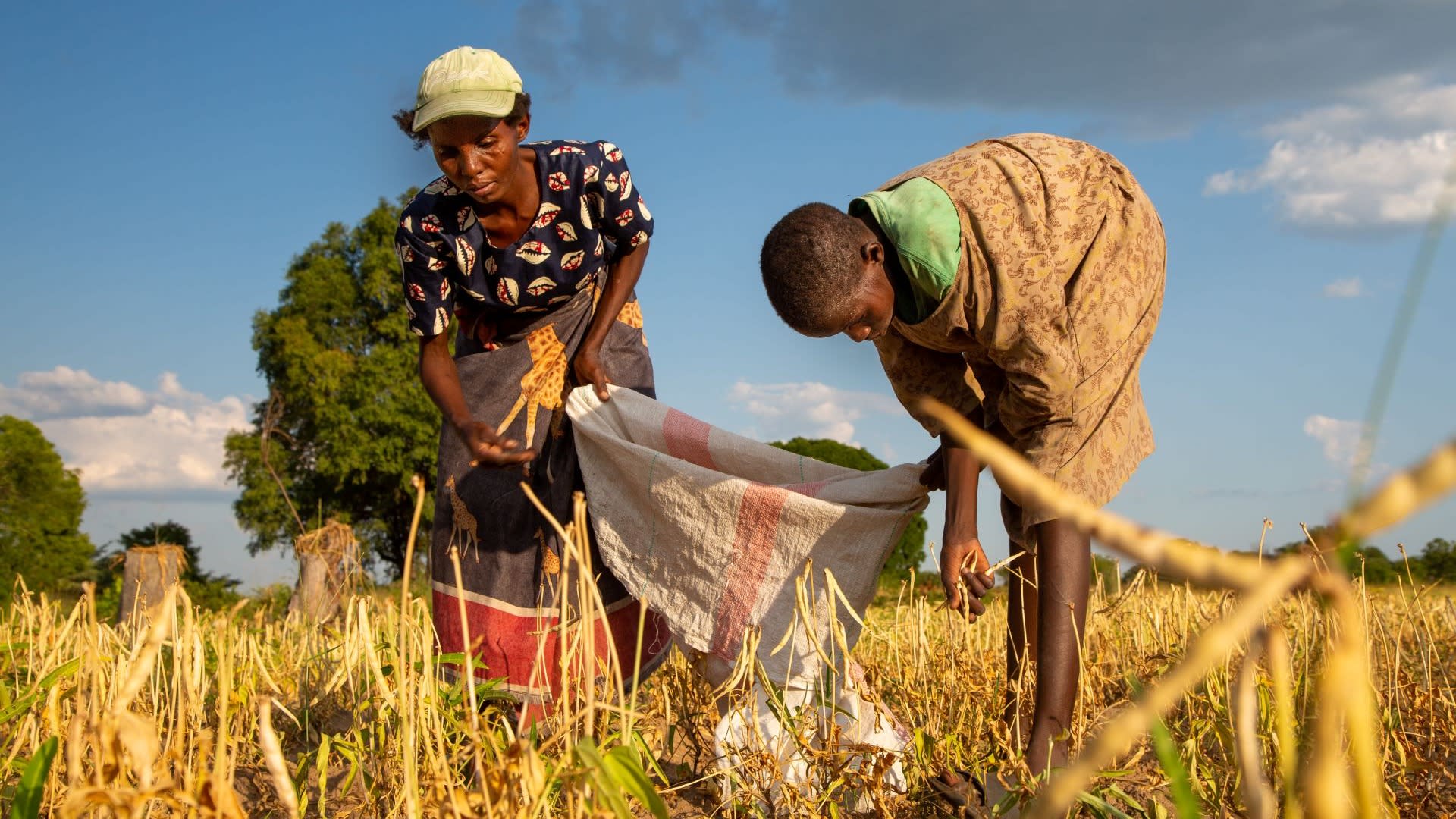
There are moments when an old idea suddenly becomes relevant again. In Zambia, as we look toward another potentially difficult climate season, one such idea can be found not in a modern economic textbook, but in an ancient agricultural instruction: do not harvest the corners of your field.
Leviticus 19:9–10 and Leviticus 23:22 instruct farmers not to reap their fields completely or gather everything from the edges. What remained was to be available to the poor and vulnerable. Deuteronomy 24:19 contains a related principle: if a farmer forgot a sheaf in the field, it was to be left behind rather than collected again. Together, these formed part of a broader system of agricultural provision for vulnerable people.
At first glance, this may appear to have little to do with climate change, agricultural insurance or Zambia's food-security challenges. But there is a deeper economic principle embedded in the practice: in times of abundance, deliberately preserve something that can protect society in times of scarcity.
That principle was the inspiration behind a paper I wrote in 2023 titled Njala (Hunger) Insurance – Pharaoh and Joseph Climate Change Adaptation Strategy in Zambia.
The idea was simple: if Zambia is increasingly exposed to droughts, floods and unpredictable agricultural seasons, perhaps we should think differently about how farmers insure themselves against hunger.
The conventional insurance model requires a farmer to pay a premium, usually in cash, in exchange for protection against a future loss. But for a smallholder farmer whose income is largely tied to the harvest, finding cash to pay an insurance premium can itself be a challenge. Why not allow part of the harvest to become the insurance contribution?
This is the basic idea behind Njala Insurance.
A farmer could, for example, contribute a small percentage of their maize harvest to a structured food-security reserve. Rather than selling or consuming every kilogram produced in a good year, a small portion would be deliberately set aside. In a bad year, that reserve could be used to provide food, income support, seed or other assistance to farmers and communities affected by climate shocks.
It is, in essence, an agricultural insurance mechanism built around the physical commodity rather than solely around money.
The idea also draws from the biblical story of Pharaoh and Joseph. When Joseph interpreted Pharaoh's dreams as a warning of seven years of abundance followed by seven years of famine, his recommendation was not to wait for the famine before acting. Egypt was advised to use the years of plenty to accumulate reserves that could be drawn down when food became scarce.
The economic lesson is timeless: a society that consumes all of its surplus during good times leaves itself dangerously exposed when conditions change.
Zambia knows this lesson particularly well.
Agriculture remains highly dependent on rainfall, while climate variability is making the traditional assumptions about farming seasons increasingly unreliable. Drought does not only reduce maize production. It affects household incomes, livestock, food prices, electricity generation, government finances and the ability of farmers to purchase inputs for the following season. A climate shock can quickly become a broader economic shock.
This is why the conversation about climate adaptation needs to move beyond what happens after a disaster.
We tend to think of resilience in terms of what the government will do when a drought occurs: how much maize will be imported, how much relief will be distributed, how much money will be allocated and how vulnerable households will be supported.
But insurance works differently. Insurance asks us to prepare before the disaster.
The developing El Niño provides another reason to have this conversation now.
El Niño does not automatically mean that Zambia will experience drought, and every El Niño event is different. But Southern Africa has historically experienced significant rainfall disruptions during some El Niño events, and the emergence of a strong event should give policymakers, farmers and businesses reason to think seriously about climate preparedness.
The important question is therefore not whether we can predict exactly what the 2026/27 agricultural season will look like.
We probably cannot.
The better question is whether Zambia can build systems that remain useful even when our predictions are wrong.
That is where Njala Insurance becomes interesting.
Imagine a farmer harvesting 100 bags of maize. Instead of treating all 100 bags as immediately available for consumption or sale, perhaps five are designated as a resilience contribution. The farmer retains the other 95. Across thousands or millions of farmers, those small contributions could create a significant physical reserve.
The reserve could be managed through cooperatives, accredited warehouses or other appropriately regulated institutions. Digital records could track who contributed, how much was stored and what quantity remains. Weather data and agricultural monitoring systems could help determine when a particular region is experiencing a significant climate shock. Mobile money could support financial compensation where appropriate.
The idea could also be combined with conventional agricultural insurance.
A farmer might contribute grain to a physical reserve while also participating in weather-index insurance. The physical reserve would provide food-security protection, while financial insurance could compensate for income losses. Government could potentially provide some form of subsidy for vulnerable farmers without having to carry the entire cost of disaster response.
This would turn the traditional concept of a grain reserve into something more distributed and participatory.
Instead of food security being something held entirely by the state, farmers themselves could become participants in the resilience system.
But there is an important warning.
Njala Insurance should not become another government programme where grain disappears into warehouses, payments are delayed and political considerations determine who receives assistance. The concept would only work if it is built around transparency, accountability and trust.
Every contribution would need to be recorded. Every kilogram would need to be accounted for. Storage losses would need to be independently monitored. Release conditions would need to be established before a crisis occurs. Farmers would need to know exactly what their contribution entitles them to receive when a qualifying event takes place.
Technology could make this considerably easier than it was in the past.
A digital platform could create a farmer-level record of contributions. Warehouse operators could maintain digital inventories. Satellite imagery and weather stations could provide independent evidence of drought conditions. Statistical models could monitor production risks. Mobile payments could distribute compensation. Blockchain may even have a limited role in creating auditable commodity records, although the basic system does not require fashionable technology to work.
The important innovation is not the software.
It is the institutional design.
The deeper lesson from the "corners of the field" is that resilience can be built into ordinary economic behaviour. Farmers do not necessarily need to wait for a government programme to arrive after a disaster. Communities can deliberately preserve a portion of their production before the crisis.
That is what makes the idea worth discussing in Zambia today.
Climate adaptation is often presented as something requiring billions of dollars in new infrastructure. Those investments are important. Zambia needs irrigation, climate-smart agriculture, better meteorological systems, drought-resistant crops, improved storage and resilient energy infrastructure.
But adaptation is also about institutions.
It is about designing systems that allow society to absorb shocks without collapsing.
A farmer who keeps part of a harvest in reserve is practising a form of adaptation. A community that maintains a grain reserve is practising adaptation. A country that builds strategic food stocks before a drought is practising adaptation.
Njala Insurance simply attempts to formalise that instinct.
Perhaps Zambia could test the concept rather than debate it indefinitely. A pilot could begin with a few cooperatives in drought-prone districts. Farmers could voluntarily contribute a small percentage of their maize harvest. The pilot could measure participation, storage costs, farmer satisfaction, losses, food-price effects and the ability of the reserve to provide support during a shock.
If it works, the model could expand.
If it fails, Zambia would learn something relatively cheaply.
That is preferable to discovering the weaknesses of our food-security system in the middle of a national drought.
The biblical instruction about the corners of the field was never intended as an insurance policy in the modern actuarial sense. But it contained a powerful economic idea: do not consume everything when times are good. Leave something behind for the day when circumstances change.
That principle has survived in different forms across human societies. Today, we call it reserves, insurance, buffers, contingency funds and risk management.
Perhaps we can call one version of it Njala Insurance.
As Zambia watches the climate, the economy and the next agricultural season, we should not only ask how much we can produce.
We should ask how much of what we produce we are prepared to preserve.
Because the most effective response to tomorrow's hunger may begin with what we are willing to leave in the corners of today's fields.